
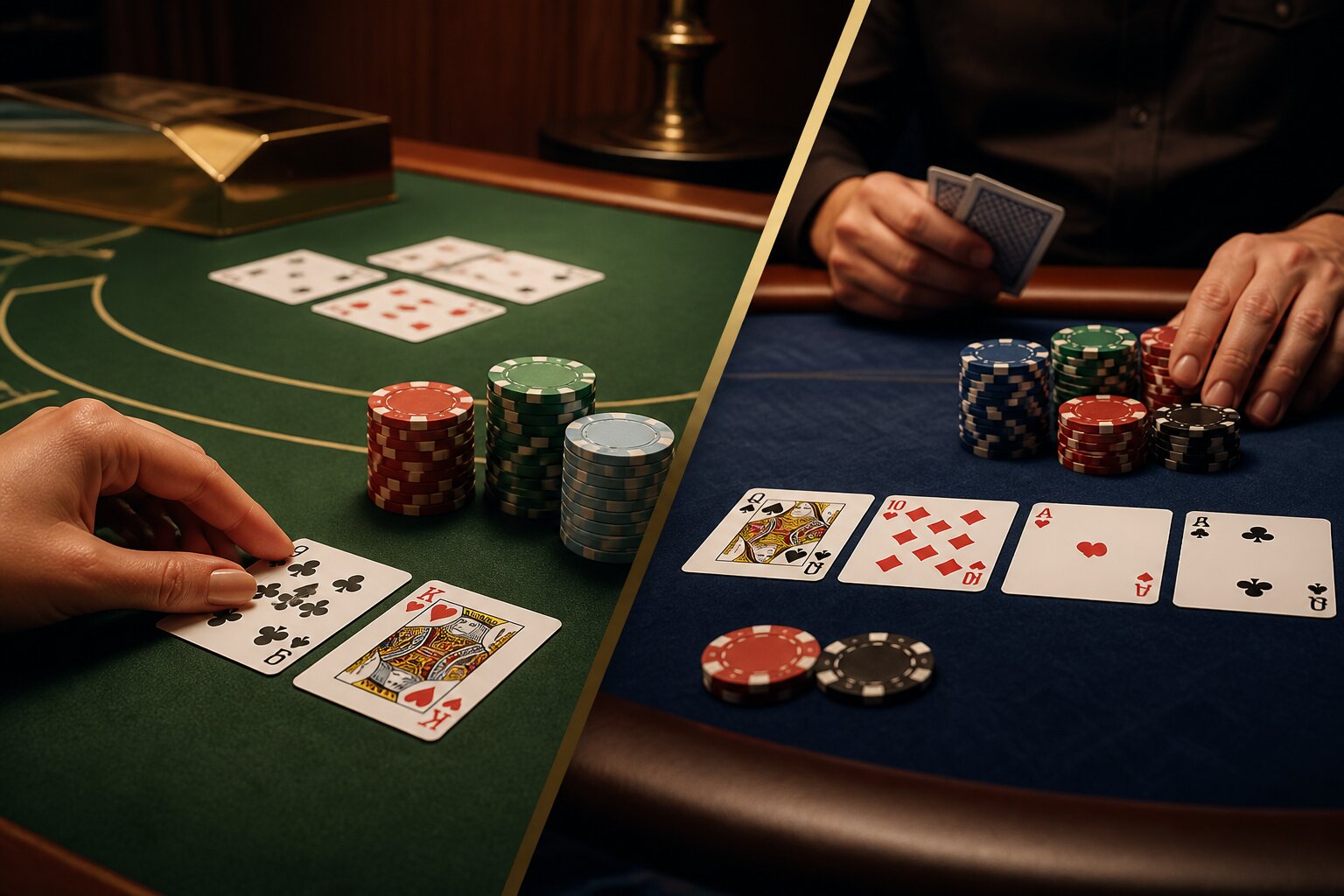
Ever wondered which suits you better — baccarat or poker? These two card classics offer very different experiences: one gives a streamlined, predictable structure, the other invites strategic play against other people. Both can be rewarding in different ways, depending on what you want from a session.
Choosing between them can feel tricky, especially if you’re new or want to try something different. Each has its own rules, betting rhythm and statistical profile, and those differences shape how the games feel and what skills are useful.
Curious to see how baccarat stacks up against poker? Read on to learn how each game works, which gives you better long-term expectation, and what kind of table atmosphere each creates.
What Are the Main Differences Between Baccarat and Poker?
Baccarat and poker both use standard playing cards, but they diverge in purpose and play. Baccarat is a betting game where players back one of two dealt hands or a tie; after bets are placed, dealing and any card draws follow fixed rules. Players do not make decisions about keeping or discarding cards, and there’s no direct contest between players.
Poker is a competitive card game where each participant builds a hand and acts on it — betting, folding or raising — over several rounds. Success depends on reading opponents, choosing when to invest chips, and adapting strategy as the hand unfolds. Unlike baccarat, poker outcomes hinge on player choices as well as the cards that appear.
Bets in baccarat are simple and immediate; poker’s betting is iterative and tactical. That difference shapes everything from table dynamics to the skills a player develops.
Understanding the Rules: How Is Each Game Played?
Baccarat is straightforward to follow. Players select one of three bets: Player, Banker or Tie. Two hands are dealt and scored according to specific values; the aim is for a hand’s total to be closest to nine. Face cards and tens count as zero, aces are worth one and number cards use their face value. If a total exceeds nine, only the final digit is counted. Once bets close, the dealing and any third-card rules are applied automatically.
Poker comes in many forms; Texas Hold’em is the best-known. In Hold’em each player receives a set number of private cards and shares community cards on the table, using those to form the best five-card hand. Betting occurs across several rounds, and players may fold or continue depending on the evolving pot and their read on opponents. The winner is the last player remaining after betting concludes or the one with the highest-ranked hand at showdown.
Both games are intended for adults and involve financial risk; it’s wise to play within set limits.
Comparison of Card Values and Scoring Systems
Each game uses card values to very different ends. Baccarat converts card ranks into single-digit totals: 2–9 keep their values, aces equal one, and tens and face cards count as zero. Totals over nine reduce to the final digit, which makes scoring quick and predictable — a 7 and an 8, for instance, count as 5.
Poker preserves conventional card order for ranking hands. Aces can be high or low depending on the hand (for example, in a straight), and suits are equal. The game evaluates combinations — pairs, two pairs, straights, flushes and so on — to determine the strongest five-card hand. That emphasis on combinations and relative rank, rather than a fixed numeric target, is what gives poker its strategic depth.
These contrasting systems explain why baccarat is fast and mechanical, while poker rewards pattern recognition and positional judgement.
How Do the Odds of Winning Compare?
The mathematical profiles of the two games differ markedly. Baccarat’s options and outcomes are limited, so expectations are easier to state. Statistically, backing the Banker produces a slightly lower expected loss for players than backing the Player, and the tie wager carries a substantially higher expected loss. Those figures reflect how the game’s rules affect outcomes over many rounds.
Poker’s expected results depend heavily on the number and skill of opponents, blind structures and the rake taken by the house. Because you compete against other players, skilled decision-making can shift long-term results in your favour — provided your opponents are less consistent. The house still earns from the game through a percentage of each pot, but it does not win or lose hands in the same way as in banker-backed games.
Whichever game you choose, understand the statistical profile and set sensible bankroll limits before you play.
Player Interaction and Table Dynamics
Baccarat tables tend to be calm and procedural: players place bets and then observe the dealer and the automated card rules. That quiet rhythm can suit people who prefer minimal social engagement and a steady pace.
Poker tables are interactive by design. Players compete and the atmosphere is shaped by betting, bluffing and table talk. Observing opponents and interpreting their actions are integral skills; the social interplay directly affects decisions and outcomes. These dynamics make poker more variable from hand to hand and often more engaging for those who enjoy contest and psychology.
If you prefer low-interaction play, baccarat may be the better fit. If you enjoy reading people and influencing the flow of the game, poker is likely more appealing.
Which Game Is Easier for Beginners?
Baccarat’s simplicity makes it easy to pick up quickly. With only a few betting choices and automatic dealing, a newcomer can join a table and participate without needing to memorise complex strategy.
Poker requires investment in learning rules, hand rankings and the subtleties of betting. New players often benefit from studying common scenarios — for example, how position affects the value of a speculative hand — and from experience reading opponents. While the initial learning curve is steeper, the game also offers a clearer path for skill development and long-term improvement.
Both games reward preparation: baccarat through understanding its odds and bet types, poker through practice and study.
Myths and Misconceptions About Baccarat and Poker
Misconceptions can create false expectations. In baccarat, for example, patterns in previous outcomes do not change the rules that determine each new hand’s result. Treating sequences as predictive can lead to poor staking choices.
In poker, myths about guaranteed strategies or the need to bluff constantly can misdirect effort. Bluffing is a tool among many; effective play blends betting discipline, hand selection and situational judgement. Similarly, belief in betting systems that promise steady profit misunderstands how probability and opponent behaviour shape results.
A realistic view of how each game operates — and what parts are controllable — helps players make better decisions at the table.
Comparing the House Edge in Baccarat and Poker
Baccarat’s house edge is explicit and easy to cite: the Banker and Player bets carry small, fixed expected losses for players, while the Tie wager has a far larger expected loss. Those percentages reflect the long-run mathematical expectation of the game’s rules.
Poker does not have a direct house edge in the same way, because the contest is player-versus-player. Instead, the house earns through a rake, a fee extracted from each pot. The size and structure of the rake influence profitability for regular players and are an important consideration when comparing long-term expectations between games.
Knowing how the house recoups revenue in each game is essential when assessing which offers a better fit for your goals and time at the table.
How Do You Choose the Right Game for You?
Choosing between baccarat and poker comes down to personal priorities: the pace you enjoy, the social element you want and whether you prefer a game governed by fixed rules or one shaped by ongoing decisions.
Consider what you enjoy. If you favour quick, low-decision rounds with clear outcomes, baccarat provides that straightforward rhythm. If you enjoy reading opponents, adjusting strategy and influencing pot sizes, poker offers that interactive challenge.
Learn the rules before you play and try low-stakes or demo versions to get a feel for each game’s tempo and table culture. Set a budget and time limits so sessions remain controlled and enjoyable — many sites provide tools to help manage play.
Ultimately, the best choice is the one that fits your temperament, your goals and the way you want to spend your time at the table.
**The information provided in this blog is intended for educational purposes and should not be construed as betting advice or a guarantee of success. Always gamble responsibly.