
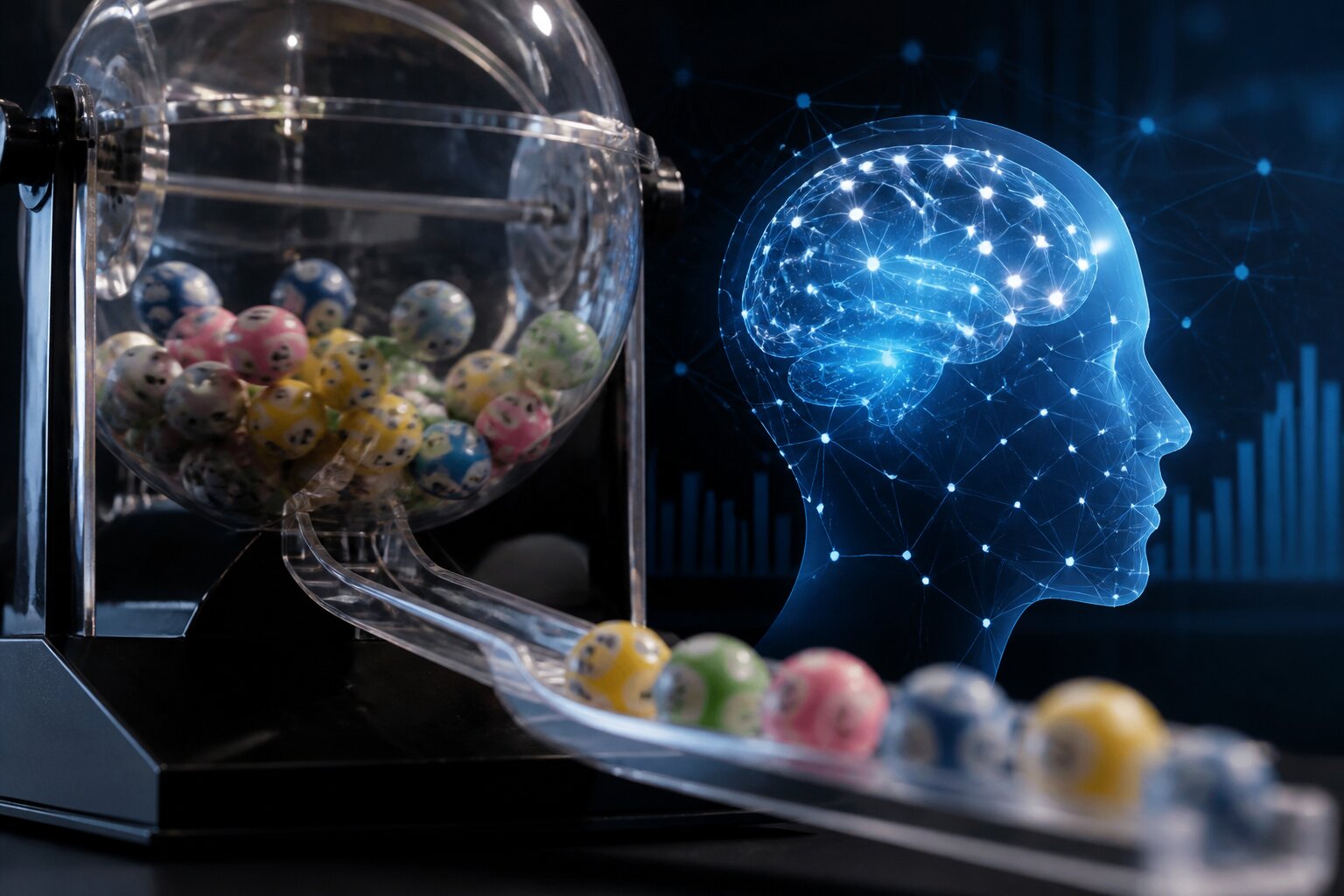
Imagine handing your lottery slip to a computer and, with a few clicks, finding next week’s winning numbers. The thought grabs attention, especially when jackpots run into millions of pounds. Artificial intelligence has seeped into many parts of life, so it is natural to wonder whether it can make sense of lottery draws too.
AI already helps with tasks such as voice recognition, fraud detection and traffic forecasting. But when a game is engineered to be random, the rules that let machines learn from past data no longer apply. The question is not whether AI can work with data, but whether there is any useful signal to learn from in a truly random process.
How Do Lottery Draws Actually Work?
Lottery draws are set up to ensure every possible outcome has the same chance of occurring. In many draws, numbered balls go into a transparent drum and are mixed mechanically or with air jets. At the official time, a predetermined number of balls are drawn and displayed as that round’s results.
Some modern games use certified random number generators instead of physical machines. These are software systems tested and audited to confirm they produce unbiased, unpredictable sequences. Throughout the whole process there is strict oversight, independent adjudication, and public visibility so that nobody can influence the outcome.
Because each draw is an independent event and the mechanisms are designed to remove bias, past results do not provide a reliable basis for predicting future draws. That independence is why attempts to forecast outcomes face a scientific barrier rather than a technical one. This distinction between how draws are run and what AI needs to learn is central to understanding the limits of prediction.
Understanding AI: What Can Artificial Intelligence Really Do?
Artificial intelligence excels when there are repeatable relationships in data. It can detect correlations, learn patterns and create probabilistic forecasts where past behaviour helps predict the future. That is why AI is useful in areas like fraud detection, personalised recommendations and analysing sports performance.
However, prediction depends on the existence of patterns. In games designed to be random, there is no underlying pattern for algorithms to exploit. AI can process enormous databases of past draws, but if those draws are independent, the output is no more informative than a random selection. In such cases AI’s strength in pattern recognition does not translate into predictive power.
AI remains useful around lotteries in other ways. Operators can use machine learning to monitor transactions for fraudulent activity, to personalise customer interfaces, or to ensure compliance. These are legitimate applications that rely on observable behaviour, not on trying to forecast inherently unpredictable outcomes. If you are curious about whether the technology behind AI could ever break this barrier, the next section explains why the mathematics of randomness makes that highly unlikely.
The Science Behind Randomness in Lotteries
Randomness in lotteries means that every draw is independent and every valid combination has equal probability. Whether numbers come from a mechanical drum or a certified random number generator, the process is built to ensure unpredictability and fairness.
Random number generators are implemented using algorithms that have been tested by independent experts. Tests measure statistical properties such as uniformity and lack of correlation to confirm there is no bias. Physical draws are also designed so that mechanical or procedural factors cannot create a predictable pattern.
Because of this engineering, even vast computing power cannot reveal a secret rule that determines future draws. Probability theory shows that without dependence between events, past outcomes have no bearing on the next result. That mathematical reality is what makes prediction infeasible for legitimate lotteries, and it underlines why purported systems that promise better odds are not supported by science.
Common Myths About AI and Lottery Predictions
A common belief is that analysing historical draw data will expose hidden patterns that an AI can learn. In practice, independent draws provide no stable signal to learn from, so such analyses do not increase predictive accuracy. Another myth holds that software can choose "less common" number combinations to reduce the chance of sharing a prize. While selecting unusual combinations might change how a potential jackpot is shared, it does not change the chance of winning in the first place.
Claims that AI can "crack" a lottery by analysing millions of past results misunderstand the nature of randomness. Similarly, services that promise guaranteed wins or sell proprietary algorithms are misleading. These offers often rely on persuasive marketing rather than verifiable evidence and can misrepresent the true statistical position.
Understanding these misconceptions helps separate reasonable uses of technology from deceptive claims. With that clearer picture, it is worth looking at how people choose numbers and whether there is any meaningful difference when compared with algorithmic approaches.
AI vs Human Lottery Strategies: Is There a Difference?
People choose numbers for many reasons: memorable dates, personal routines, or patterns that feel comfortable. Some use systems such as sticking with the same numbers week after week, while others prefer random selections like quick picks. Human choices often reflect habit rather than statistical advantage.
When AI is used to suggest numbers, it typically mines historical draws for apparent trends or uses algorithms to produce selections that avoid commonly chosen combinations. The goal in some cases is not to improve the probability of winning, which cannot be changed, but to limit the chance of sharing a prize if a win occurs. That is a strategy about prize splitting rather than prediction.
Ultimately, both human and algorithmic selections face the same mathematical odds. The practical difference lies in psychology and risk management: machines may produce more varied combinations, while humans often pick familiar patterns. That behavioural contrast matters for how a jackpot would be divided but does not alter the underlying probability of a draw. Next, consider the legal and ethical context surrounding services that claim predictive power.
Legal and Ethical Concerns with AI Lottery Prediction
AI’s applications in gambling-related contexts raise regulatory and ethical questions. Using software to generate personal number selections is legal, provided it does not claim to affect official draws. The crucial boundary is between offering tools for private use and promoting systems that assert an ability to change outcomes.
Advertising standards and consumer protection law prohibit misleading claims. Services that assert guaranteed wins or suggest their tools can influence a random draw risk breaching these rules. Operators and marketers have a duty to be clear about what a product does and does not deliver.
Ethically, offering predictive systems that give people unrealistic expectations can cause harm. Promotions that prey on those chasing large returns may encourage excessive spending. Responsible providers focus on transparency, clear odds information and safeguards for customers. With these protections in place, users can make informed choices without being misled by impossible promises.
The Bottom Line: No System Can Beat Lottery Randomness
Advances in artificial intelligence do not change the fundamental mathematics that govern legitimate lotteries. Draw mechanisms are constructed to remove bias, and randomness means past results do not influence future outcomes. Therefore, no technology can reliably forecast winning numbers or guarantee a win.
AI does have practical roles around lotteries, such as fraud detection, compliance monitoring and improving user interfaces, but prediction of genuine random draws is not one of them. Claims to the contrary should be treated with scepticism and checked against independent evidence.
As an operator, I encourage people to view lottery play as entertainment rather than an investment, to make purchases only if aged 18 or over, and to be wary of any service promising guaranteed outcomes. With that clear perspective, players can enjoy games knowing the rules and the odds, and without chasing unfounded claims.
**The information provided in this blog is intended for educational purposes and should not be construed as betting advice or a guarantee of success. Always gamble responsibly.