
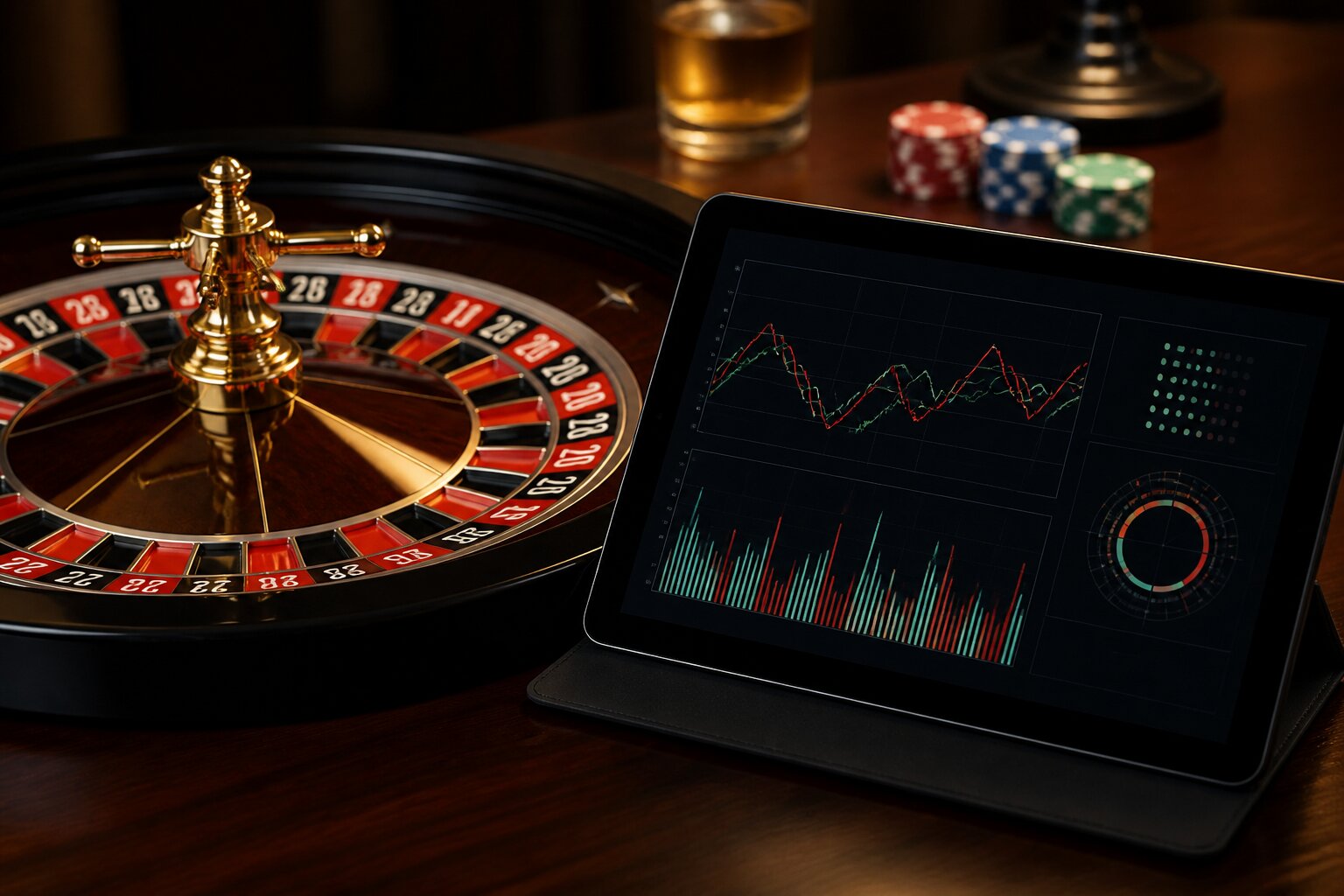
Ever wondered if a small gadget could predict where the roulette ball will land? Stories about high-tech devices promising to "crack" the wheel have circulated for decades, and they keep drawing attention.
This article examines those claims, explaining how these devices are said to work, what evidence exists, and what the legal and practical realities are. Read on to separate the technical explanations from the marketing hype and decide whether this is a credible route for a player.
How Do Roulette Computer Devices Work?
Manufacturers describe roulette prediction gadgets as compact instruments that collect timing information during a spin. A user records moments such as the wheel speed or when the ball passes a fixed point, sometimes by pressing a hidden button. The device runs on quick calculations and outputs a prediction for a section of the wheel where the ball might land.
Some models relay their result to an earpiece, a small display or a smartphone app, allowing discreet use at the table. The underlying idea is that the physics of the wheel and ball motion, together with precise timing, could reduce uncertainty about the final sector.
In practice, the system relies on a number of assumptions: that the wheel and ball behave consistently, that timing measurements are accurate under pressure, and that external factors do not significantly alter the outcome. Those assumptions are difficult to guarantee during live casino play, where equipment is regularly maintained and many variables are at play.
What Are the Claims Behind Prediction Technology?
Sellers typically present several claims to make their devices appealing. They often say the gadget can detect subtle patterns in the wheel or compensate for small mechanical biases. Marketing materials may state that the device reduces the house advantage and can be mastered with practice.
Some adverts frame their product in scientific terms, referencing physics and mathematics to suggest reliability. Others emphasise stealth and ease of use, promising that casino staff will not detect the device.
These claims should be treated with caution. Independent verification is scarce, and promotional material naturally highlights best-case scenarios. When evaluating such products, it helps to ask for peer-reviewed testing or neutral third-party assessments rather than relying on selective testimonials.
Are Roulette Prediction Devices Legal in the UK?
Under UK law, the use and possession of equipment designed to cheat at casino games is a criminal matter. The Gambling Act 2005 and related regulations are intended to protect the integrity of gambling, and anyone caught with unauthorised devices could face criminal investigation and prosecution. That can lead to criminal records, fines or other penalties depending on the circumstances and the seriousness of the offence.
The regulator and licensed operators take these matters seriously. The UK Gambling Commission expects operators to maintain robust controls to prevent cheating and to report suspected criminal activity. Casinos and bookmakers are required to follow strict regulatory standards and may work with law enforcement when cheating is suspected.
Casinos also have their own rules and powers. They can:
- refuse entry or remove a person from the premises,
- impose lifetime bans on players they believe have cheated,
- withhold or confiscate winnings,
- retain or destroy equipment believed to be cheating devices,
- pursue civil action or refer matters to the police.
These contractual and legal risks apply whether the device is mechanical, electronic or software based. Carrying or attempting to use such equipment in a licensed venue is therefore not a course of action to take lightly. Even attempting to use a device without causing a win can lead to severe consequences, including being banned from other venues through shared industry databases.
If you are unsure about the legality of any product or accessory, seek independent legal advice or contact the Gambling Commission for guidance. Compliance with the law and with venue rules protects both operators and players and helps ensure games remain fair for everyone.
Can Prediction Devices Actually Beat the Roulette Wheel?
Roulette outcomes are intended to be unpredictable. Casinos operate procedures and maintenance regimes to keep wheels within tight tolerances, and modern surveillance plus routine inspection reduce the chance of persistent mechanical bias. As a result, long-term predictable patterns are rare in regulated venues.
Academic and independent examinations of claimed prediction systems have not produced robust, reproducible evidence showing a consistent long-term advantage against regulated roulette. Many published tests find that apparent short-term gains fall away once larger sample sizes or controlled conditions are used. Reports of success are often anecdotal, lack appropriate controls, or do not rule out ordinary statistical variance as an explanation.
The result of each spin depends on a large number of micro-variables that are difficult to measure accurately in a live casino setting, for example:
- the exact speed of the wheel at release
- the speed and angle of the ball
- tiny imperfections or variations on the wheel surface
- environmental factors such as temperature and vibration
Because casinos keep equipment within regulated standards and because these variables interact in complex ways, reliably improving expected returns with a portable device remains unproven. Any claim to the contrary should be treated with scepticism and examined under rigorous, repeatable testing.
Common Myths & Misconceptions About Roulette Computers
There are a number of recurring misconceptions. One is that technological progress automatically makes these devices effective today. In reality, improvements in casino equipment and surveillance tend to offset advances elsewhere.
Another myth is that discretion guarantees safety from detection. Casinos watch games from multiple angles and have staff trained to notice unusual behaviour. A third misconception is that a single device can produce consistent winnings; the complexity and variability of live play make that unlikely.
Understanding these misconceptions helps to separate marketing spin from realistic expectations. Devices may offer interesting demonstrations, but that is not the same as consistent, law-abiding advantage in regulated settings.
What Risks Are Involved With Using Prediction Devices?
Legal risks are significant. Possible outcomes include:
- prosecution,
- fines,
- permanent banning from venues.
Beyond those penalties, legal action can also lead to criminal records, civil claims for losses and costs, and the expense of legal representation.
Financial risks can be substantial. Buying a prediction device is often a poor investment if it does not perform as expected, and any apparent advantage can be negated by restrictions or countermeasures implemented by operators.
Casinos and betting venues frequently reserve the right to void suspected winnings and recover losses. This can leave users out of pocket and unable to reclaim their outlay for the device or related expenses.
There are also ethical concerns around fairness. Using unauthorised equipment:
- distorts the integrity of the game,
- harms other players’ experience,
- undermines trust in the venue and among participants.
For these reasons, involvement with prediction technology carries reputational as well as material consequences. Being associated with dishonest practices can affect future employment, membership of clubs and standing in social circles.
Think of these risks together rather than in isolation. The legal, financial and ethical stakes combine to make the proposition unattractive for most people, and the cumulative harms often far outweigh any short-term gains.
How Do Casinos Detect and Prevent Prediction Technology?
Casinos use a layered approach to detection and prevention, combining human oversight with technical systems. High-resolution cameras capture table activity from several viewpoints. Security teams and surveillance operators monitor live and recorded feeds for suspicious behaviour, unusual patterns and activity that falls outside normal play.
Floor personnel and dealers are trained to watch for irregular movements, the presence of concealed devices at the table, and anything that might indicate coordinated action between players. Staff training is refreshed regularly so teams remain alert to new methods and trends.
Many venues also carry out certification and routine inspections of wheels, equipment and dealing procedures. These checks reduce the chance that a mechanical bias or fault could be exploited and provide a documented audit trail that can be reviewed if concerns arise.
Operators frequently deploy technical countermeasures as well. These may include signal-detection systems to identify unauthorised electronic transmissions, analytics that flag statistical anomalies in game outcomes, and chip- and card-tracking technologies that improve traceability.
Together, these layers make it difficult for prediction gadgets to operate undetected for long. Regular audits, prompt incident response and a focus on fair play help casinos protect customers and maintain the integrity of their games.
Should You Trust Roulette Computer Device Reviews?
Reviews are often written by parties with a commercial interest in promoting a product. Testimonials can be selective and may not disclose testing conditions or the involvement of professional gamblers. Independent, controlled evaluations are rare, and many reviews omit whether the reviewer was paid, received free equipment, or benefits from affiliate links.
Look for signs of bias, such as overly positive language, lack of critical detail, or a single source of praise repeated across sites. User forums and social media can be useful, but they also contain sponsored posts and coordinated campaigns that can distort the apparent consensus.
When assessing reviews, look for transparency about:
- the testing methodology used,
- independent third party testing or verification,
- reproducible results and clear data that others can check.
If those elements are absent, treat positive claims sceptically. Buying on the basis of persuasive marketing is a common way to waste money on unproven tools, and relying on unverified devices can give a false sense of control.
If your priority is a safe and enjoyable experience, focus on reliable sources and verified information rather than following promotional claims. Consider reviews from recognised independent testers, documented user studies, and publications that disclose conflicts of interest. Above all, be cautious and avoid spending money based on hype alone.
Conclusion: Is Prediction Technology Worth Considering?
Prediction devices may look attractive at a glance, but the combination of legal prohibition, limited independent evidence and active casino countermeasures makes them an unwise option for most people. They carry serious consequences and have not been shown to deliver consistent advantage in regulated environments.
For those who want a genuine casino experience, the sensible choice is to engage with games within the established rules and the protections that regulation provides. If you are curious about the technical side, there is interesting physics and engineering to explore in a theoretical or academic context, but using such knowledge in a venue where it conflicts with law or policy is not recommended.
**The information provided in this blog is intended for educational purposes and should not be construed as betting advice or a guarantee of success. Always gamble responsibly.