
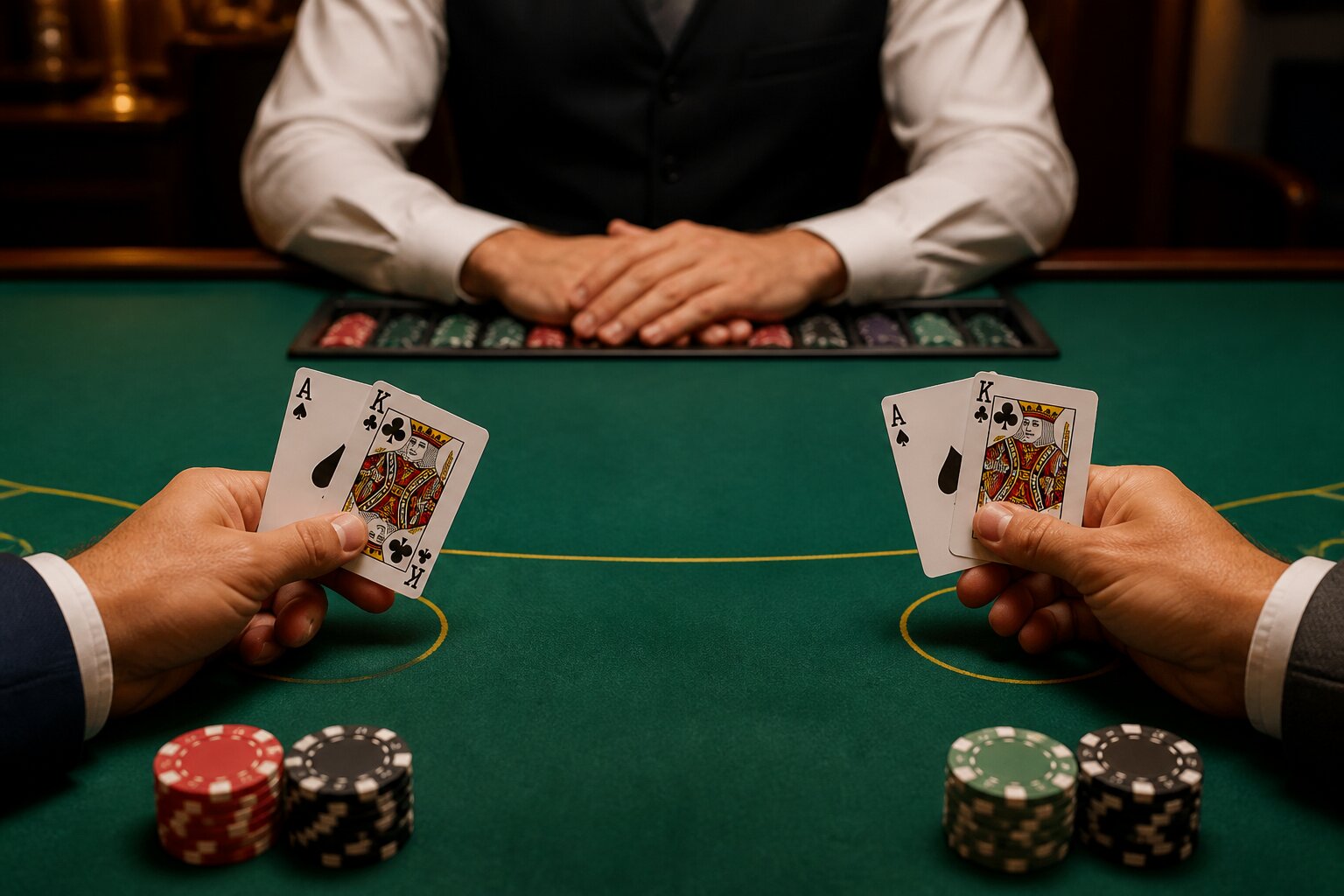
Picture the scene: you’re sitting at a busy blackjack table, adrenaline pumping, and both you and another player hit twenty-one in the same round. Your cards add up just right, but then so do theirs. It’s a classic casino moment that leaves many people wondering what actually happens next.
Blackjack has moments of real tension, and few compare with two players landing the same perfect total at once. Does it matter who reached twenty-one first? Does the dealer have the final say? And how are bets settled when the table splits its attention?
If you’ve been at a table with this situation or are simply curious about the rules, the answers are straightforward once you know how outcomes are decided and how different formats can change the picture.
What Happens When Two Players Both Hit 21 in Blackjack?
When two players both hit 21, the important point is that blackjack is a contest between each player and the dealer, not between players. Each hand is settled independently against the dealer’s cards, so two people holding 21 do not affect one another’s outcome.
If the dealer also has 21, the typical result is a push, which means each affected player’s original stake is returned. If the dealer’s total is lower than 21, each player who has 21 is paid as a winner, generally at even money. These settlements are handled per hand, so two or more winners are simply paid separately rather than splitting a communal pot.
There are exceptions in alternative formats, such as tournaments where players compete for ranking or prize pools rather than against the dealer. Those formats have their own rules for ties and payouts. Next, we’ll look at how standard pushes and natural blackjacks are dealt with in practice.
How Are Ties Resolved in Blackjack?
In standard play, a tie between a player and the dealer is called a push. A push returns the player’s stake with no win or loss recorded for that hand. This rule applies regardless of the number of players who share the same total.
A natural blackjack, an Ace paired with a ten-value card dealt first, often receives the same treatment in a tie: if both player and dealer have naturals, bets are typically returned. In game variants where tournament or head-to-head formats are used, ties may affect points or prize splits according to the published rules of that event.
These procedures keep settlements clear and consistent, which is why it helps to glance at the table rules before play begins. The next section outlines the core rules you’re most likely to encounter at the table.
Key Rules for Tied Hands at 21
Tied hands follow established, simple principles designed to make outcomes fair and transparent. Below are the core points that guide settlements and player expectations.
Do Players Split the Pot?
Players do not split a pot in standard blackjack because each wager is resolved against the dealer. If multiple players reach 21, each hand is compared to the dealer’s hand and settled on its own merits. This keeps individual results independent and predictable.
Does the Dealer Always Win Ties?
The dealer does not automatically win ties. When a player’s total matches the dealer’s total, the round is usually a push and the player’s stake is returned. Typical situations include:
- Player and dealer both show 21: the bet is a push and the original stake is returned.
- Player has 21, dealer has less (for example, 20): the player wins and is paid at 1:1.
- Multiple players have 21 while the dealer has less: each winning player is paid separately at 1:1.
- Player and dealer both have natural blackjacks (Ace plus a ten-value card): this is a push and the original stake is returned.
Tournament or special formats may treat ties differently, but such variations are always set out in the game rules.
With the rules clear, it helps to understand where house policies can change those outcomes and what to watch for before you sit down.
House Rules That May Affect Tied 21 Outcomes
Casinos and game operators sometimes apply specific table rules that affect how ties are treated. These variations are normally displayed at the table or explained in the game terms so players can make informed choices.
One common distinction is how a natural blackjack is ranked against a 21 made with more than two cards. At some tables, a natural may beat a multi-card 21; at others, matching totals remain pushes. There are also less common rules where a push might not return the full stake, or where tournament play splits prizes or awards points differently.
Because these differences matter for how your bets are settled, a quick look at the posted rules avoids surprises and clarifies whether particular outcomes favour naturals, multi-card totals, or tournament scoring. After this, consider how a tie might influence the practical side of your play.
Implications for Blackjack Strategy After a Tie
A push returns your stake and leaves your bankroll unchanged for that hand, which can reduce the impact of a short run without requiring an immediate change in approach. Basic blackjack strategy remains the sound foundation because it is designed to work over many hands rather than respond to single events.
That said, knowledge of the house rules can subtly influence decisions. For example, if a venue treats natural blackjacks preferentially over multi-card 21s, a player might prefer to stand more often when close to a safe total rather than risking a hit that converts a potential natural into a later 21. Conversely, an operator rule that reduces push refunds would encourage more conservative play around doubling or splitting.
Whatever the table rules, keep focus on consistent decision-making and set limits on time and spend. These habits support clear-headed play and align with the responsible practices that reputable operators promote.
Understanding how ties are settled and which house rules apply keeps the game straightforward and enjoyable, so take a moment to check the table conditions before you play.
Enjoy Casino Games at Slot Sites UK
We welcome you to explore our selection of casino games and enjoy the experience with us at your own pace. Whether you are familiar with casino entertainment or just interested in taking a look, we are always pleased to have you with us.
Getting started is straightforward: simply create an account, make a deposit and you are ready to play. We look forward to seeing you on our site.
**The information provided in this blog is intended for educational purposes and should not be construed as betting advice or a guarantee of success. Always gamble responsibly.